Creed is always a pleasure to work with! He is prompt, friendly and efficient.
Karen Wheeler
18:27 22 Oct 26
Erin Sheppard
11:43 22 Oct 26
Caleb is a super nice guy, easy to talk to and gets the job done!
Penny Robinson
00:04 22 Oct 26
Good work by great people. My service tech Creed is aces! Always pleasant, professional and knowledgeable. Highly recommend Bug Man and be sure to ask for Creed when you call.
Mitchell Fritz
18:37 20 Oct 26
Great service and professionalism.
Scott Bogen
17:33 20 Oct 26
Linda Reid
16:46 20 Oct 26
Cory is great! Reliable, polite and gets the job done!
Susan Anderson
16:02 20 Oct 26
Trace visited today for our quarterly maintenance. He spent a few minutes chatting with me and answering questions I had on costs, services included and ways to address our current stink bug issues. He was professional, knowledgeable and friendly to work with - thank you!
Jason Cash
14:54 20 Oct 26
Our experience is always one of satisfaction. Everyone is always nice courteous and efficient.
Elizabeth Kennett
14:04 20 Oct 26
Hillary Osgood
12:23 20 Oct 26
David Claus
10:14 20 Oct 26
I requested for the back porch to be sprayed for stink bugs. I also covered and removed items I was not concerned about. Please make a note on the account to include the back porch moving forward. Thank you!
Denise Hutton
18:20 19 Oct 26
Jeffrey is the best. Always friendly and explains things to us.
Amanda Paxton
14:14 19 Oct 26
David Scott
16:21 18 Oct 26
Came out gave a quote on encapsulation ! Was very nice to work with !!
Sharon Hazelbaker
19:44 16 Oct 26
Caleb is always a pleasure to talk to and has been helping us with pest control and mosquitoes for years now… Thank you, Bug Man!9/24/26 again, well done and thanks!10/16/26 thanks Caleb! Appreciate you.
C Roby711
12:39 16 Oct 26
My parents were very pleased with Levi. His customer service went beyond expectations. He even helped them bring their groceries in. The bottom line is that my elderly parents have been taken advantage of and Levi was honest and they felt really comfortable and confident with his findings. Thanks Levi!
Tonya Williams
21:29 15 Oct 26
Verina Scroggins
20:36 15 Oct 26
Each and every time I have received fast and reliable service from your people! Very pleased!
Brenda Conner
19:35 15 Oct 26
Great job! Very detail oriented. Customer friendly.
Lori Emry
16:39 15 Oct 26
kay miller
18:22 14 Oct 26
Creed was very thorough and honest. We were happy that he didn’t find evidence of fleas in our home. Another positive experiences with the Bug Man team!
Doug Ashwell
01:21 14 Oct 26
Jeff is awesome, hes so kind, and just great. Highly recommend
Jane Taylor
18:01 13 Oct 26
Cory was great. He did his job without rousing my noisy pups!
Anne Craighead
16:38 13 Oct 26
Chrissy Brooks
19:40 12 Oct 26
Excellent as always on time friendly & efficient!
Suzanne Cronise
19:27 12 Oct 26
Wanda Hamlett
18:33 12 Oct 26
Jake is an awesome tech. He takes pride in his work and cares about the customer's need. 5 stars ***** to Jake!
Kraig Neidigh
17:22 12 Oct 26
Zach is a nice, professional young man.Thanx for great service with a smile!
Kimberly DiGiovanni
15:25 12 Oct 26
Amy Geddes
15:53 09 Oct 26
Levi is great but would have liked a heads up to when he was coming over. I was home sick the day he showed up and would have rescheduled for another day.
Teresa Mcfaul
12:27 09 Oct 26
G B
13:54 08 Oct 26
I’ve had much better results from Bug Man than from previous pest control companies. Additionally, Creed is always polite, professional and thorough.
Erin Mills
19:53 07 Oct 26
Mike N
18:16 07 Oct 26
Bugman always does a great job. Very Professional and knock it out! I’ve been a customer for years!!
Stuart Smith
16:35 07 Oct 26
Dorothy Alleyne
13:52 06 Oct 26
Pleasant and knowledgeable service from Josh
Cindy Almurshidi
13:42 06 Oct 26
The representative was very polite and professional! I would recommend Bug Man Extermination to other's! Thanks
John Wimmer
22:28 05 Oct 26
Nice guy, was on time, did the best he coud.
Omaid Sharifi
14:39 05 Oct 26
Karen Haralson
13:35 05 Oct 26
Creed does a great job, we have had zero issues. We're glad we switched to Bug Man.
Kaitlyn Hayslett
21:04 02 Oct 26
Raymond Perdue
20:45 02 Oct 26
Very nice and Professional !
mikey wimmer
18:39 02 Oct 26
Roger King
17:56 02 Oct 26
Quick, efficient and very knowledgeable!
Beth Brickey
15:39 02 Oct 26
Angela Seymour
14:11 02 Oct 26
Bug man is highly recommended by me. Their customer service and their techs are the best!
Eddie Burnett
19:17 01 Oct 26
Creed did a great job as always!
Robert Woolwine
21:57 30 Sep 26
Creed is thorough and efficient . He makes a point of checking whether I am having any particular issues before he starts. He is a very polite young man.
Barbara Fulgaro
19:31 30 Sep 26
Wendy smith
17:52 30 Sep 26
Matt from Bug Man came out to inspect a yellow jacket issue in the siding of my home. He was knowledgeable, professional, and took the time to explain the yellow jacket issue as he worked through the inspection and treatment process. He carefully identified where the yellow jackets were entering the siding and explained the recommended treatment to address the nest and prevent the problem from continuing. I appreciated his thoroughness, clear communication, and willingness to answer my questions throughout the service visit. He did an excellent job addressing the issue and made me feel confident that it was being handled properly.
Todd Fisher
14:00 30 Sep 26
Creed was very respectful of our do not ring the doorbell sign (we both work from home). I asked him to do the garage and he was happy to help. Super friendly and thorough!
Jamie Hampton
13:38 30 Sep 26
Sara Powers
17:33 29 Sep 26
Lynne Sexton
15:41 28 Sep 26
Been using them for years. Always great service.
Stephanie Alderson
19:43 27 Sep 26
I love having Bug Man come and keep the bugs away!Always prompt, friendly and professional!They always say that if I have any problems to please call and let them know!
Billie Sage
20:43 26 Sep 26
Very professional and courteous.
Cliff Bowyer
18:00 26 Sep 26
Donna Padis
03:32 26 Sep 26
Jennifer Barger-Helms
20:15 25 Sep 26
Creed called ahead to let me know when he would arrive, and he showed up on time. He was respectful and did his work efficiently.
Melissa Freeman
17:45 25 Sep 26
Listens to the needs of the customer and always has a pleasant attitude. We enjoy working with him as he does what we discuss and completes his tasks in a timely manner.
Listener 1440
14:50 25 Sep 26
Tammy Smith
01:01 25 Sep 26
Prompt, thorough, and effective service for a ground hornet nest in the eaves of the house.
Guy Hellier
16:47 24 Sep 26
Called the office at 9:00am and a crew was dispatched and resolved our issue by 12:00 noon same day!!! I know this can’t always be the case, but between the response, and quality service (with a smile as well) we are Bug Man customer's for life!!!
Ray Shelor
16:29 23 Sep 26
Michelle Musser
15:34 23 Sep 26
First rate performance every time!
Skip Wheeler
16:43 22 Sep 26
bugs gone! fast service, fair prices, expert level knowledge.
Kelly DeLucia
16:27 22 Sep 26
Was able to get in quickly and did job efficiently
OBXTanner Hurley
13:57 22 Sep 26
We use bug man for all our pest control needs. They are knowledgeable, courteous, trustworthy, on time, and products are effective. Have ants? You won’t anymore. Have mice -not anymore. Have basement bugs - no longer. I really appreciate that their products are earth and pet friendly as well.
Bryan Webb
21:44 21 Sep 26
Quick response when I needed them. Friendly service technician.
Richard Lester
18:17 21 Sep 26
Brian Brooks
17:25 21 Sep 26
Great work and exceptional customer service!
Eddie Easterling
16:04 21 Sep 26
Thoughtful, courteous, and proactive
Sherri McG
14:48 21 Sep 26
Derek was extremely professional getting me a quote for my crawl space encapsulation which honestly surprised me, considering I know him personally. 😂 He showed up, explained everything clearly, answered all my questions, and gave me a thorough quote. For a few minutes, I almost forgot who I was dealing with! All jokes aside, Derek did a great job, and I’d definitely recommend him and his crew for future projects like this .
David Hopkins
16:59 19 Sep 26
Actually I havnt been home much, daughter in hospital. Im sure he did a good job. Thanks!
Karen Wilson
18:34 18 Sep 26
Lavar C
13:36 17 Sep 26
Gentleman was very knowledgeable and did a great job. Easy to deal with
Lenee D Brown
21:35 16 Sep 26
Corey is great. He has been here a few times.He remembers where everything in the house is located.
Eugene Brush
16:47 16 Sep 26
Dianne Roberson
15:15 16 Sep 26
Very nice, good work.
Noflai Zone
14:49 16 Sep 26
Caleb arrived in time. He was very professional!
DEB HOFBAUER
17:43 15 Sep 26
Very pleased with the service. Caleb is very professional and pleasant. Highly recommend Bug Man Exterminating.
Charles Webster
23:23 14 Sep 26
I was very pleased with the service and the service representative.
Mike Wohlford
19:41 14 Sep 26
Debbie Foutz
18:36 14 Sep 26
Josh did an amazing job and was efficient. The whole team at Bug Man has been so helpful and joyful. I cannot recommend them enough for the peace of mind and the safe handling practices to keep everyone bug free and safe while applying their chemicals/products.
Aaron Horton
14:27 14 Sep 26
Prompt service! On time and very thorough.
Rhonda Roop
19:05 13 Sep 26
Stacey Nichols
00:59 12 Sep 26
Matt was super responsive to our concerns and enthusiastic about his work. Great experience :)
Anne Silber
22:32 11 Sep 26
Caleb was very thorough and professional. Exceptional service and I highly recommend Bug Man
Michael Herron
19:31 11 Sep 26
Creed was very professional and informative. Was very respectful around the house during the inspection. An excellent experience.
R DB
17:27 11 Sep 26
Jacob clearly met our expectations. He was respectful, courteous, polite and extremely professional throughout the process.
Joseph Journiette
18:22 10 Sep 26
Lynne Holbrook
18:50 09 Sep 26
Great customer service and Technician was great with service and communication!
Kristen Ingram
18:05 09 Sep 26
Trace is to be commended. We were very disappointed with our last Bug exterminator company. . We decided to go with Bug Man andTrace met our complete expectation and he took his time to take down all the spiderwebs on the entire house and around windows and doors. He was very thorough. He walked through our house and made sure every room and corner was treated. He went outside and took down cobwebs and dead spiders up under the eaves and underneath our 20 foot ceiling deck. We cannot say how happy we are with our service. I also signed up for the yearly inspection for Termites. Thank you Bug Man and Trace.
Linda Benda
16:58 09 Sep 26
The staff are always pleasant and helpful. He is very considerate and friendly.
JoAnne
13:43 09 Sep 26
He is so polite and ask if any problems and sprays where needed. He does a great job and would recommend He to anyone. He is an asset to your company.
What started at the Pennsylvania border is now in your neighborhood. Roanoke, Salem, Blacksburg, Christiansburg, the spotted lanternfly is here, it’s growing, and this summer it’s active. Call Bug Man Exterminating, today, for fast, effective spotted lantern fly control.
For a few years, Roanoke Valley residents watched spotted lanternfly news roll in from up north and assumed it was someone else’s headache. Then, in the span of a single season, that changed.
Virginia Cooperative Extension agents in Roanoke fielded call after call from homeowners watching the pest colonize their trees. Virginia Tech entomologists in Blacksburg confirmed what everyone was starting to see: the spotted lanternfly has adapted to life in Southwest Virginia, and it’s not going anywhere.
60–70%
of Virginia now has confirmed spotted lanternfly populations
2018
Year SLF was first detected in Virginia. It has spread every year since.
What changed last year: In Roanoke County, spotted lanternfly went from a handful of sightings to trees and plants covered with the pest — almost overnight. The Virginia Department of Agriculture confirmed populations so widespread that the state’s formal quarantine was lifted in March 2025. Not because the problem was solved — but because it had spread too far to contain.
Confirmed in These Southwest Virginia Areas
Roanoke City
Roanoke County
Salem
Montgomery County
Radford
Bedford County
Botetourt County
Carroll County
Wythe County
Rockbridge County
Blacksburg
Christiansburg
Source: Virginia Department of Agriculture and Consumer Services (VDACS), 2025–2026. Populations are actively expanding.
What Are You Looking At?
The spotted lanternfly is one of the easier invasive pests to identify (once you know the life stages). It looks different depending on when in the year you spot it. Here’s what to look for in each season.
Fall — Spring
Egg Mass
October – April
Looks like dried mud or putty. Gray-brown smears about an inch long. Found on tree bark, wooden fence posts, patio furniture, stone walls, and even car bumpers. Each mass holds 30-50 eggs.
Check the rough bark of silver maples and Tree of Heaven, along fence lines, and on any hard surface near the woods.
Spring
Early Nymph
April – June
Wingless, about a quarter-inch long. Black body with bright white spots arranged in rows. Fast-moving and often found feeding on young stems, leaves, and low-growing plants.
Easy to miss individually, but they gather in numbers. Check the undersides of leaves on young trees and along shrub stems.
Summer
Late Nymph
July – August
Still wingless but now larger, over half an inch. The black-and-white pattern now shows vivid red patches across the body. Highly mobile; found aggregating on tree trunks in large groups.
This is the stage most commonly reported on tree trunks in Roanoke and Salem neighborhoods. Hard to miss once populations are established.
Late Summer — Fall
Adult
August – November
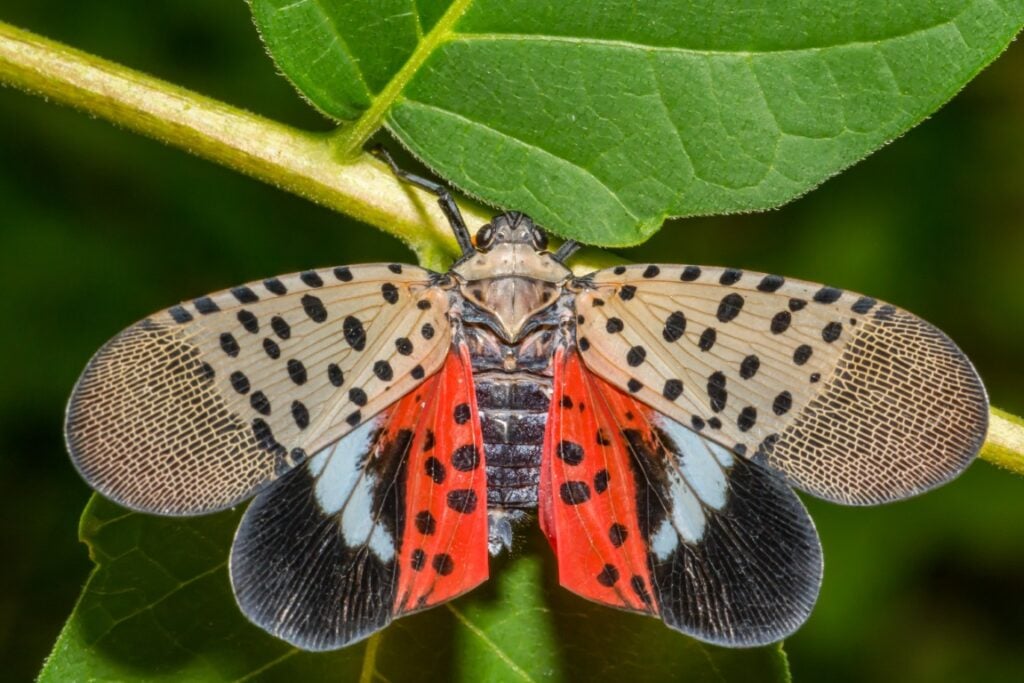
Roughly an inch long. Mottled gray-brown forewings with black spots, brilliant scarlet hindwings with black spots and white bars. The hind wings are only visible in flight. At rest, the bug looks spotted gray-brown.
Unmistakable when the wings open. Adults aggregate in large numbers in late fall, especially on Tree of Heaven, silver maple, and fruit trees.
Not sure what you are looking at? Spotted lanternflies are hitchhikers — they lay egg masses on vehicles and outdoor gear. If you have been to the Shenandoah Valley, the I-81 corridor, or an area with confirmed populations, check the undercarriage and bumpers of your vehicle when you return home.
Spotted lanternflies don’t bite or sting people, and they’re not structurally damaging to your home. But the damage they do to your property, your trees, and your outdoor living spaces is real, and it compounds quickly when populations go untreated.
Your Trees and Landscaping
The spotted lanternfly feeds by piercing bark and sucking sap from the cambium layer of trees. Its preferred hosts in Southwest Virginia include silver maple, black walnut, wild grapevines, and the prolific Tree of Heaven, which grows along nearly every roadside in the Roanoke Valley. Repeated feeding weakens trees, leaving them vulnerable to disease, secondary pest infestation, and eventual die-off.
Ornamental maples and established shade trees that took decades to grow are particularly at risk on residential lots. Young fruit trees may not survive a heavy infestation.
Gardens, Fruit Trees & Vines
Grapevines, hops, apple trees, peach trees, blueberry bushes, and ornamental plantings in your yard are all documented feeding hosts. Virginia’s wine country extends into Bedford and Franklin Counties — and the vineyards there are watching closely. Homeowners with backyard gardens and young fruit trees face the same risk on a smaller scale. SLF stress can set back years of establishment growth in a single season.
The pest was originally a major concern for commercial agriculture. In residential SW Virginia, backyard orchards and vegetable garden trellises are seeing the same kind of pressure.
Your Outdoor Living Spaces
As spotted lanternflies feed, they excrete a sticky substance called honeydew that coats everything beneath the affected tree — your deck, patio furniture, children’s play equipment, and vehicles parked nearby. That honeydew ferments in Southwest Virginia’s summer heat, develops a black sooty mold, and draws in secondary pests: wasps, yellow jackets, ants, and hornets. An infestation can make your outdoor spaces genuinely unpleasant to spend time in.
Multiple Roanoke Valley homeowners last season reported a sticky black film on patio furniture and decks beneath heavily infested trees — within weeks of populations arriving.
A Word on Southwest Virginia’s Landscape
The wooded lots, mature hardwood corridors, and mixed-use landscape of the Blue Ridge foothills create ideal habitat for the spotted lanternfly. Tree of Heaven, SLF’s most preferred host, grows aggressively along I-81, I-581, the Roanoke River Greenway, and throughout the New River Valley. That means the pest has no shortage of launching points into neighborhoods, and properties bordering wooded areas or roadside growth are at the front of the spread. Dense residential neighborhoods in Roanoke City, Salem, and the Cave Spring corridor are seeing the same pressure as more rural properties in Botetourt and Floyd counties.
How Bug Man Handles Spotted Lanternfly
We’ve been fielding spotted lanternfly calls across Roanoke and Montgomery Counties since populations took off. Our approach is thorough, targeted, and built around how this pest actually behaves in Southwest Virginia (not a generic protocol copied from a manual).
01
Property Inspection
Your technician walks the full property to map the situation: host trees present (Tree of Heaven, silver maple, black walnut, wild grape), active nymph and adult populations, egg masses on hard surfaces, and areas of heaviest feeding pressure.
We identify the problem completely before recommending a treatment.
02
Targeted Treatment
We apply an exterior perimeter barrier treatment using EPA-approved insecticides consistent with Virginia state agricultural recommendations, including bifenthrin-class products proven effective against spotted lanternfly nymphs and adults. Where appropriate, direct tree treatments are added for high-pressure host trees on your property.
Treatment is targeted. We protect your yard without unnecessary broad applications.
03
Egg Mass Removal
Every egg mass left on your property in the fall is next spring’s infestation. Our technicians locate and destroy egg masses on trees, deck railings, fence posts, outbuildings, and other hard surfaces. We’ll show you exactly what to look for so you can stay on top of it between our seasonal visits.
Fall egg removal is critical. Don’t skip it if you want to start the season ahead.
04
Year-Round Protection
Spotted lanternfly is a year-round presence in Southwest Virginia. Our Four Seasons Pest Control plan builds SLF monitoring and treatment into every scheduled visit — active-season treatments in spring and summer, egg mass work in fall, and monitoring through winter. No gaps, no scrambling when populations spike in July.
Four Seasons customers are covered without having to call and schedule each time.
Already a Four Seasons Customer?
Spotted lanternfly treatment and monitoring can be incorporated into your existing plan. Give us a call or mention it on your next service visit and your technician will add a property assessment to their next scheduled stop. No separate appointment needed in most cases.
These are the questions we hear most often from homeowners in the Roanoke Valley and New River Valley.
No. Spotted lanternflies do not bite, sting, or carry disease. They are harmful to plants and trees, not to people or animals. That said, if you have dogs, cats, or other pets that spend time in the yard, we always use pet-safe application methods. Our technicians will ask about your pets before beginning any treatment and will let you know when it is safe for animals to re-enter treated areas.
You can take meaningful action in every season, but the approach changes depending on what stage of the life cycle you are targeting. Spring through summer (April through August) is the best window for active insecticide treatments targeting nymphs and adults while they are mobile and feeding.
Fall through early spring (September through March) is egg mass season. The focus shifts to locating and destroying overwintering egg masses before they hatch in April. If you do the fall work, you start each spring well ahead of the population. The strongest programs address both windows, which is exactly how our Four Seasons plan is structured for Southwest Virginia.
You can make a dent. Killing adults and nymphs on sight helps, and scraping egg masses with a plastic card into soapy water is genuinely effective as a supplemental measure. Virginia Cooperative Extension has good homeowner guidance worth reading.
The challenge is scale. In Roanoke County and Montgomery County, populations have grown dense enough that even a well-managed property can be re-colonized from neighboring trees within days of treatment. DIY efforts work best as a complement to professional perimeter and tree treatment, not as a standalone strategy when an infestation is established.
A few reliable signs to look for: groups of adults or nymphs gathered on tree trunks or stems (they aggregate, so you will often see many at once); gray putty-like smears on rough bark, fence posts, or deck railings; a sticky wet residue on surfaces beneath affected trees; black sooty mold developing on leaves or patio surfaces; and an unusual number of wasps or ants gathering near your trees in summer.
If you are on a wooded lot, near any roadsides with Tree of Heaven, or in neighborhoods where neighbors have reported sightings, it is worth having an inspection even if you have not spotted the insect itself. Egg masses are easy to miss until you know what you are looking for.
Yes. We serve residential and commercial properties, rental and investment properties, and small farms throughout the Roanoke Valley and New River Valley. If you manage land with fruit trees, ornamental plantings, timber stands, or small-scale vineyards and hop yards, we can build a treatment plan around your property’s specific needs and the timing that matters most to you. Call our Roanoke or Christiansburg office to get started.
Treatment cost depends on property size, the number and type of host trees present, and how active the infestation is. We do not quote from a national price table — we give you an honest estimate based on what we actually see on your property.
We always start with a free inspection. There is no cost to have a Bug Man technician walk your property, assess the situation, and give you a straightforward recommendation. No contracts required. If you decide to move forward, you will know exactly what you are paying for before we start any work.
Spotted Lanternfly Season Is Active Right Now.
Populations across Roanoke County, Montgomery County, and the surrounding valley are growing year over year, season over season. The window you’re in right now is one of the most effective times to treat. Our technicians are local, licensed, and have been working in this landscape for years. They know the pest, they know Southwest Virginia, and they’ll get out to your property fast.
Serving: Roanoke · Salem · Vinton · Blacksburg · Christiansburg · Radford · Bedford County · Botetourt County · Floyd County · Carroll County · Wythe County